
How to Measure Bracelet Size? Common Mistakes To Avoid
ByPerry Xu
Shopping for hand bracelets requires knowing your wrist size to pick a piece that isn’t too tight or too loose.
This is especially important for online shoppers who can’t test bracelets before making a purchase. Even in some physical stores, you may not be able to test everything on the shelf before making your pick. This blog is a detailed guide on how to measure bracelet size.
Contents
How to Measure Your Wrist Size for a Bracelet?
When you are about to get a custom stainless steel bracelet or buy a ready-made type, one of the information designers and sellers require is the size of your wrist. This information is crucial. Without it, you won’t be able to wear your jewelry accessory elegantly. So, here are different methods of measuring your wrist.
Measuring With a Tape
Measuring with tape is one of the easiest ways to measure your wrist accurately. Follow these steps to measure your wrist with a tape:
- Get a measuring tape and put it around your wrist. Run it around the part of the wrist where you typically wear your bracelet. Ensure you have a starting point, and take note of where the tape meets
- Use your hand to hold on to where the tape meets or the endpoint so you can see the length. You can also use an object to mark the spot. The goal of this is to get the length correctly.
- Whatever your length is in centimeters (CM), add 1.5 cm extra, and that will be your bracelet size. The extra is to ensure your bracelet isn’t too tight. However, if you’ve given allowance for an extra width when measuring, then you do not need to add the 1.5 cm.
Here’s a video to help you understand the steps better.
Measuring Without a Tape
Apart from measuring with a tape, you can also use other methods. So if you find yourself without a measuring tape, you can also use a ruler. Since a ruler can’t bend, look around and find things like thread, a shoelace, etc. The steps on how to measure bracelet size are as follows:
- Get a piece of tiny wool, thread, or a shoe lace.
- Run the thread or shoelace around your wrist in a way you want your bracelet to fit. Take note of where it ends, using your fingers to mark the spot. You can also use chalk or anything else to mark the spot.
- Next, place the thread, wool, or shoelace on or beside the ruler to measure it. If the thread was snuggly wrapped around your wrist when measuring, add about 1.5 cm to add length to give extra room for the bracelet to fit well.
- The total length recorded is your bracelet size.
In addition to these measuring methods, you can use your bracelet to get your size. If you already have a bracelet that you like, then you can measure it to know your size. Simply place your bracelet on or beside a measuring tape or ruler to get the length. If it’s a piece of bangle, you can use a thread to measure the inner part.
Bracelet Size Chart in cm and inches
A bracelet size chart shows you measurements in different units. It shows measurements in centimeters and inches. This is important because your measuring tape might only have readings in inches, while the seller might have sizes listed in centimeters.
For example, your measuring tape might show that your wrist size is 7 inches. However, the seller might have bracelet sizes in centimeters (cm). Instead of doing the conversion math yourself, you can rely on a chart to check the equivalent of 7 inches in centimeters.
A size chart is universal for stainless steel, gold filled, brass, and sterling silver bracelets.
Also, a size chart classifies different length sizes into categories: small, average/ medium, and large.
Bracelet Sizing Chart
| Wrist Size (inches) | Wrist Size (centimeters) | Bracelet Size |
| 5” | 12.7 | Small |
| 5.5” | 13.9 | |
| 6” | 15.2 | |
| 6.5” | 16.5 | Average/ Medium |
| 7” | 17.7 | |
| 7.5” | 19.1 | Large |
| 8” | 20.3 | |
| 8.5” | 21.6 |
Choosing the right size for different bracelet styles
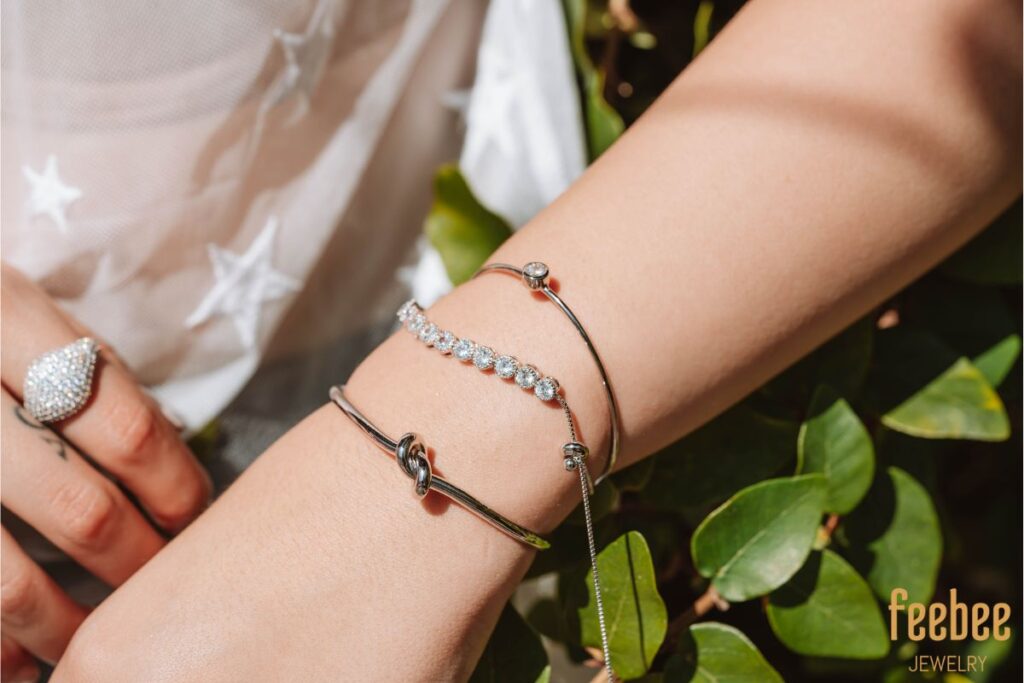
Bracelets come in different styles, such as tennis bracelets, bangles, etc. Since the design of bracelets varies, you need the right measuring method to choose the right size.
If you want to get a tennis bracelet that is designed to be firm around your wrist, then you simply need to:
- Use a measuring tape or thread that goes firmly around your wrist and get the measurement.
- You may add about 1.5 cm or 0.591 inch to your measurements.
To put this into perspective, let’s say you use a tape or thread that is firm around the wrist to get the length. If the length is 6.5 cm, you may add about 1.5 cm to ensure it’s not too tight. However, if you already left some space when measuring, then the extra length may not be needed.
In the case where you’re measuring for bangles, your measurement will be slightly different because bangles are designed to be loose around the wrist. So when measuring for your bangles, do these:
- Run a measuring tape or thread around your wrist and leave enough space that will allow you to remove your bracelet over your hand.
- Remember that you still want to leave some room for a loose fit.
Adding extra length can be tricky here, so make sure you give enough space when measuring.
Common Bracelet Measuring Mistakes
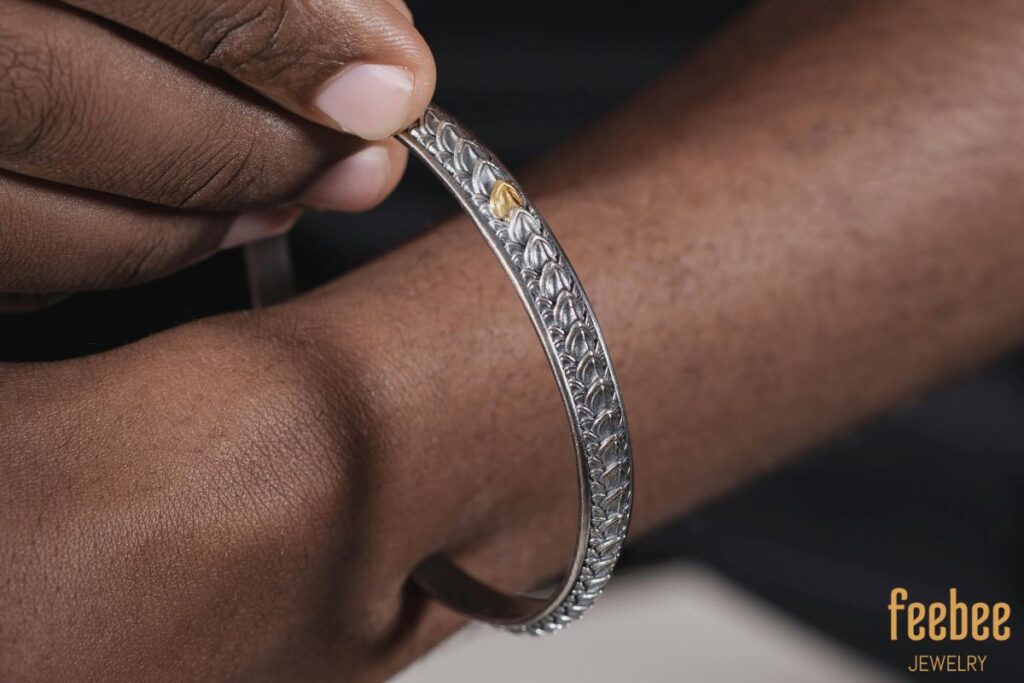
When measuring, there are a few mistakes people make that often affect the comfort of their bracelets.
- Measuring just one hand: The ideal way to measure is to check both wrists. It’s not unusual that one wrist might be slightly bigger than the other. If you measure just one, you might experience a perfect fit on one hand, and a loose or tight fit on the other.
- Measuring over sleeves: So people forget to pull up their sleeves when measuring. Some may even make the mistake of measuring over another bracelet that they have on. If you don’t measure your wrist directly, you may end up with a bracelet that is too loose.
- Measuring too tightly or loosely: Measuring too tightly or loosely can affect the fit of a bracelet. This happens when the measuring tape or thread is too tight during measurement or too loose.
Another reason is that some don’t factor in the type of bracelets they are about to purchase. If you measure your wrist too firmly when you’re about to get bangles, it may not fit.
- Neglecting temperature change: A temperature change can cause a bracelet to feel loose. A once-fitted bracelet can become loose when the temperature rises. This measuring mistake affects the fit of a bracelet.
Conclusion
Measuring your wrist to know your bracelet size is straightforward. The process doesn’t require any expert or special knowledge. You can use a measuring tape, thread, or string to measure the length of your wrist. If you have a perfect fit bracelet already, you can measure it to get the size of your wrist. Whenever you want to get the size of your wrist, remember to always avoid errors by measuring both wrists, giving some allowance in case of a temperature change, and considering the type of bracelet you’re getting. When you do all these, you’ll have a bracelet that is not too tight or too loose.
FAQ
How do I convert wrist size to bangle size?
Use a bracelet size chart to convert your bangle size from centimeters to millimeters and inches. Bracelet size charts usually have sizes in at least three measurement units.
What is the standard size of a bracelet?
The standard bracelet size for women is between 7 and 7.5 inches, and 7.5 to 9 inches for men.
How do you know what bracelet size to choose?
You can know the bracelet size to choose by measuring your wrist with a measuring tape, thread, or string. Take note of the length and add a little extra to give your bracelet enough room to avoid tightness.
Feebee Jewelry handles a large production and distribution of bracelets and other types of jewelry. We have a team of professionals on standby to respond to any questions you may have.

Perry Xu